I built the road before the sensors
The first data point that makes the whole journey, from the field to the cloud, and why I started with the least spectacular part.
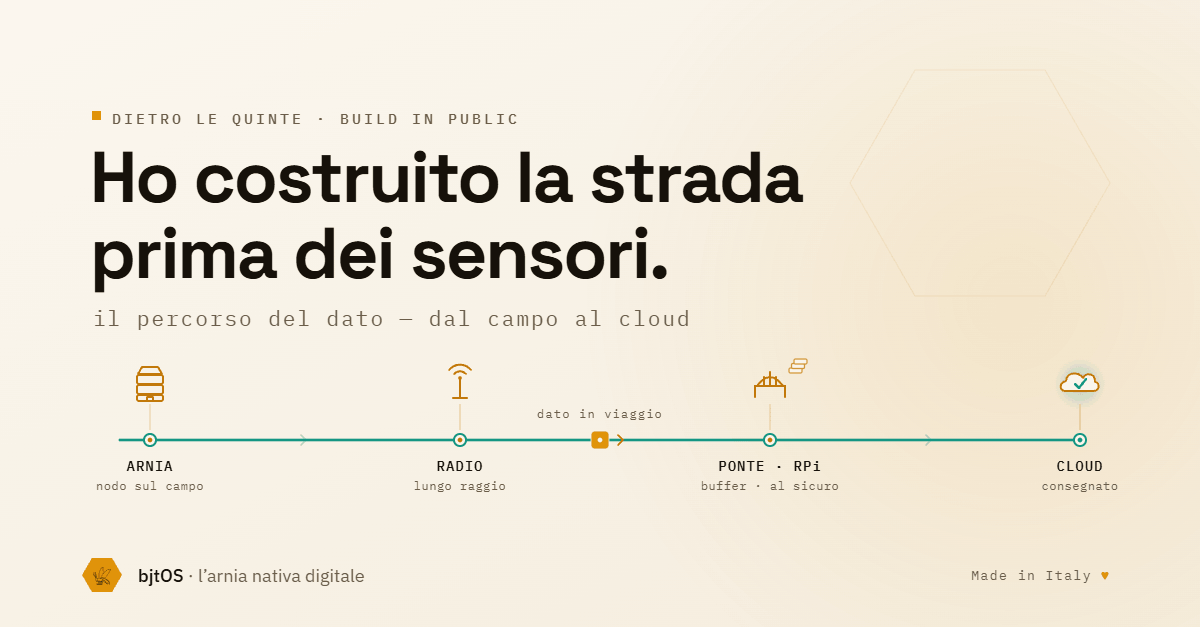
There’s a temptation, when you build a connected object: to start from the part that shows. The sensor, the number, the chart that goes “wow”. I did the opposite. Before the sensors, I built the road the data will travel, and I built it thinking about how it breaks.
Because the real problem of a hive in the middle of a field isn’t reading a value once. It’s never losing that data, for months, while connectivity comes and goes, the signal wavers, something reboots. The hard part isn’t the first reading: it’s the ten-thousandth, taken on a rainy afternoon with no network.
So I started from the backbone. And in these past days, for the first time, a piece of data made the whole journey, from one end to the other.
The path, step by step
Out in the field, a transmitter sends the data over radio, long range. Near the building, a receiver picks it up and passes it to a small bridge: a tiny computer, always on, that processes nothing, it just carries. On that bridge runs a light program that does one thing, but does it well: it takes the incoming data, checks its integrity (discarding anything that arrives corrupted) and puts it in a queue, saving it to disk. Only then does it try to send it to the server in the cloud, over an encrypted channel. When the server confirms it received it, the data is marked as “delivered”.
The detail that matters is that queue. If the network drops, the data isn’t lost: it stays in line, in order, and starts moving again as soon as the connection returns. If the bridge reboots, the queue is still there. The bridge itself is meant to be replaceable: if it breaks, you set it back up and it restarts, and in the meantime nothing has been lost.
Verified from end to end: field, bridge, queue, cloud, confirmation, without a single data point lost.
Why start from the “boring” part
Because it’s the part that decides whether a project like this is a toy or a tool. Recording a hive’s hum for a few minutes, its voice, is (relatively) easy. Making sure that voice, and the thousands of fragments that will arrive over the months, truly reach the beekeeper’s screen even when the day goes wrong: that’s the real work. I chose to put it first.
Honest about where things stand
The data making this journey today is still fake: it’s produced by a test source, not by a real node attached to a hive. The next piece is exactly that: the real sensor that listens, measures and transmits from the field. But the road that data will travel is already alive, encrypted and tested. When the hive’s first real voice sets off, it will find the lane already open.
This is how I picture a digital-native hive: not sensors stuck on top, but first of all a reliable nervous system, and then the senses.
If you’ve been following the project for a while, this is the moment it really starts to move. And if you build connected things for a living, or work with bees, I’d love to know: where would you have started, with the senses or with the nervous system?